Why Acemoglu Matters
When I think of the most influential economists in recent years, the first name that comes to mind is Daron Acemoglu. Winner of the 2024 Nobel Prize in Economics and Institute Professor at MIT, Acemoglu has devoted his career to the study of institutions. His core idea is deceptively simple: the prosperity of a nation depends on whether its institutions are inclusive or extractive.
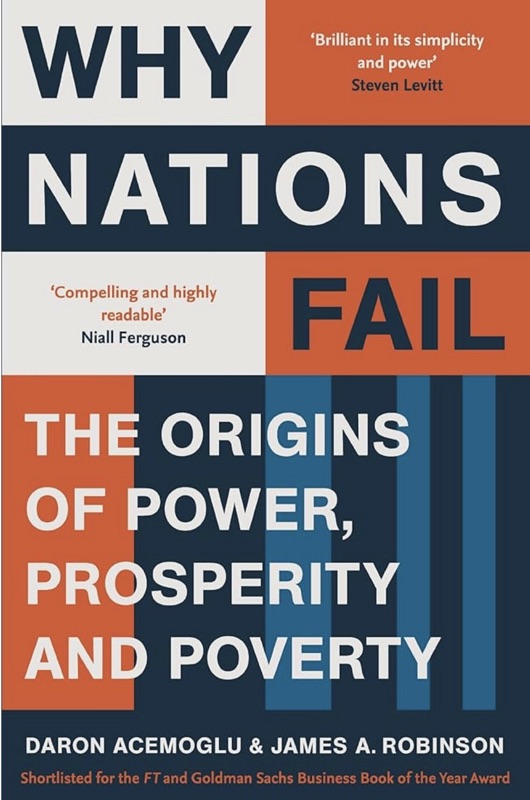
Inclusive institutions mean rule of law, secure property rights, democratic accountability conditions that allow broad participation in both economic and political life. Extractive institutions, by contrast, concentrate power and wealth in the hands of elites, leading to stagnation.
His landmark works, Why Nations Fail and The Narrow Corridor, argue that prosperity cannot be engineered from the top down through clever policy design. Instead, it emerges organically from the balance between political power and social participation. This framework has profoundly shaped the way I think about the European Union. Ironically, Acemoglu’s books sell poorly in France, perhaps because his critique cuts too close to the country’s deep attachment to humanitarian rhetoric and bureaucratic design.
Why “Designed Prosperity” Fails
Acemoglu illustrates, through countless cases, why externally imposed “good policies” often collapse in practice.
Take India’s Udaipur nurse attendance program: time clocks briefly improved attendance, but local officials with vested interests sabotaged the system, rendering it useless. Or Afghanistan’s reconstruction, where international aid was subcontracted so many times that less than 20% reached actual infrastructure.
The lesson is clear: if a policy ignores power structures and local context, it will fail, no matter how elegant it looks on paper.
To me, this applies perfectly to the European Union. Over the past twenty years, the EU has fallen from near economic parity with the United States to a GDP barely half as large. The core problem? An overreliance on “designed prosperity.”
The EU’s Three Institutional Problems
1. Over-Bureaucratization and Innovation Squeeze
From GDPR to rigid labor regulations and sweeping environmental directives, Europe’s regulatory framework has grown increasingly heavy-handed. While meant to ensure fairness and sustainability, these rules often suffocate small and medium-sized firms, leaving the field to large corporations with the resources to comply. Innovation slows, yet Brussels’ centralized authority only grows stronger.

2. Immigration Policy: Humanitarianism Meets Political Calculus
Mass immigration was once promoted as a solution to aging populations and labor shortages. In practice, many migrants particularly from the Middle East and Africa, struggle to integrate into the labor market. Employment rates hover well below those of native workers, creating fiscal burdens and fueling populist backlash.
The deeper issue is that EU immigration policy is rarely about long-term integration. Instead, it is often entangled in political incentives, where welfare promises are used to secure votes. True inclusivity requires more than handouts: it requires alignment of values, education, and civic participation. As the World Values Survey reminds us, societies differ profoundly in cultural and institutional norms. Successful integration cannot be assumed, it must be earned. Like in professional football, where players rise through tiers before joining the top leagues, newcomers must first demonstrate the capacity and willingness to adapt before being fully integrated into advanced social systems. Without this stepwise approach, “humanitarian” migration policies risk becoming extractive, strengthening elites while fragmenting society.
3. Aid Flows and Fiscal Distortions: From Bailouts to Structural Imbalances
During the Eurozone crisis, bailout money to Greece mostly went to servicing French and German banks rather than rebuilding the Greek economy. That was more than a decade ago. Today, the challenge looks different but follows the same institutional logic.
Across the EU, aid flows and fiscal transfers often reinforce existing imbalances instead of correcting them. France offers a striking example: more than half of its national budget now goes to pensions and social assistance. This leaves little fiscal space for investment in infrastructure, technology, or growth-enhancing reforms. Germany, though more disciplined, faces similar expenditure pressures.
As a result, EU funds are frequently channeled into shoring up welfare commitments or plugging budgetary gaps rather than fostering development in weaker economies. Money flows through bureaucratic layers and political bargaining, diluting its real impact. The outcome is structural: Europe’s aid and transfers consolidate the fiscal weight of core states while peripheral members remain dependent and constrained. The problem is no longer just “bailing out the banks” but systemic resource misallocation that entrenches institutional asymmetry.
France’s Special Dilemma
France illustrates Acemoglu’s critique most vividly. The country clings to a highly centralized welfare state and rigid labor laws, like the 35 hour workweek and strict dismissal rules, while maintaining high unemployment. Immigration has been managed more on humanitarian slogans than real integration, fueling tensions in the banlieues.
Acemoglu’s point is clear: prosperity requires inclusive institutions that balance power and broaden participation. Yet France’s political class resists this truth, perhaps because acknowledging it would mean questioning the very structures on which their authority rests.
Prosperity Is Institutional, Not Designed
The EU’s struggles are a living confirmation of Acemoglu’s thesis: prosperity cannot be designed by regulation, aid, or humanitarian gestures, it must grow out of inclusive institutions. Overregulation stifles innovation. Migration policies, when reduced to political calculus, deepen divides. Fiscal transfers, instead of building shared growth, often entrench structural imbalances.
If Europe wants to reclaim dynamism, it must confront its institutional weaknesses directly: lighten bureaucratic burdens, design immigration with cultural and civic alignment in mind, and channel resources into genuine development rather than perpetuating dependency.
Only then can prosperity emerge naturally from institutions, rather than remain an illusion on paper.

You must be logged in to post a comment.