A few days ago, while traveling to a small city in Germany for a business trip, I took a taxi. Before departing, I checked the distance on my phone’s map and estimated the fare to be around 18 to 20 euros. However, during the ride I gradually realized that the driver was intentionally taking a longer route, and the meter eventually stopped at about 25 euros. When I handed him 30 euros, the Middle Eastern driver said, “That’s fine,” and gestured for me to get out. Most passengers might react with anger or start an argument. As an economist, however, what I saw was a small cross-section of a social trust structure that is beginning to loosen.

Traditional economics often assumes that market participants are fully rational and that stable equilibria will emerge through repeated long-term interactions. Behavioral economics, however, reminds us that human behavior is deeply influenced by psychological biases, cultural backgrounds, and social norms. When “taking advantage in the short term” becomes a behavioral strategy for some individuals, the cost of market transactions rises. In other words, from the moment the driver began to detour, the taxi had already turned into a small laboratory.
Institutional Innovation and the “Minimization of Friction”: Why the US and East Asia See Fewer Situations Like This
Founders of behavioral economics such as Daniel Kahneman and Amos Tversky emphasized that human decision-making is not purely rational but filled with cognitive biases and bounded rationality. Among the most important are the reciprocity norm and social preferences. In high-trust societies, people tend to assume that others will follow norms and are therefore willing to act first in good faith. But when trust declines, people shift toward zero-sum thinking or defensive self-interest, and transaction costs rise sharply.
Such behavior is closely related to the level of social trust in immigrants’ countries of origin. According to long-term data from the World Values Survey (WVS), the share of people who believe that “most people can be trusted” often exceeds 60-70% in Nordic countries, while in many Middle Eastern and North African countries it is below 20-30%, and sometimes even lower. Core EU countries such as Germany and France fall somewhere in between, but their levels of trust have shown a slow decline in recent years. When migrants from low-trust cultural environments enter highly regulated societies, and when strong institutional screening or cultural adaptation mechanisms are absent, “norm conflicts” easily arise. Behaviors that may have functioned as “survival strategies” in their original environments are perceived in Europe as damaging to civilization and to social capital.
The situation is even more visible in France. Because of language and historical colonial ties, migrants from North Africa and the Arab world can more easily obtain citizenship and enter the service sector. However, this also brings stronger behavioral externalities. Café managers working with security guards to lock complaining customers in back rooms, photographing customers’ identity cards when they collect packages, or deliberately switching product barcodes at checkout to pocket the price difference, these real cases are not merely “isolated incidents.” They are systematic expressions of opportunistic behavior in low-trust environments.
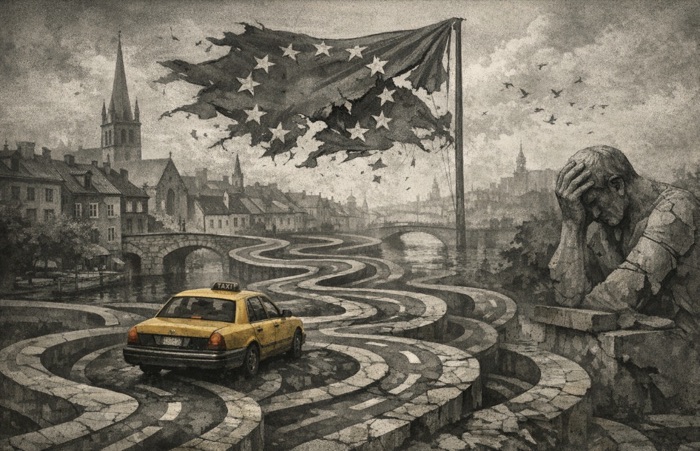
Trust is a public good. It requires institutional protection as well as support from social norms. Once trust erodes, transaction costs rise across the entire society, economic efficiency declines, and tensions between groups intensify. This is not caused by a single event but by the accumulation of many small, everyday, seemingly trivial behaviors that gradually create a structural problem.
By contrast, countries such as Japan and Taiwan maintain high-trust social environments through strict institutions and transparent rules. The United States, meanwhile, uses platform-based oversight mechanisms, such as those seen in Uber, to reduce information asymmetry through technology and limit opportunities for drivers to take detours or abuse their position. These institutional designs are essentially applications of behavioral economics: by changing incentives, increasing transparency, and lowering the gains from rule-breaking, they encourage honest behavior.
When the EU Designs Institutions Using Only “Old Economics”
Technocrats in Brussels tend to believe in the assumptions of traditional textbooks: if market competition and regulation are designed properly, people will respond “rationally” to incentives. Using the language of traditional labor economics and welfare economics, they design policies on immigration, employment, and pensions. Yet research from behavioral economics and studies on social trust are rarely truly integrated into policy models.
What traditional powers such as Germany and France are currently facing is precisely a time gap between institutions and culture. A German baker who wants to open a shop in France must face numerous obstacles, professional qualifications, language requirements, regulatory barriers, and tax rules. Yet second or third generation migrants from lower-trust societies who already hold EU citizenship can move more easily between France and Germany, entering economic networks that operate in gray areas, from vehicle and metal theft to cash-intensive restaurant money laundering and cross-border smuggling.
In practice, the EU’s principle of “free movement” reveals a certain irony: highly skilled, locally trained craftsmen are stuck behind national borders and professional regulations, while low-trust cultural networks and gray-market activities exploit the gaps created by citizenship, passports, and the Schengen system to move efficiently across the continent. This is not merely a security or cultural issue, it leaves a direct mark on long-term economic growth.
The real crisis is not the five euros. The real crisis is that Europe today is gradually shifting from a “trust society” to a “defensive society.” Bureaucrats are trying to manage a society sliding toward a low-trust equilibrium using outdated economic models and moral rhetoric. Today’s Europe is experiencing not only social fragmentation, intensifying tensions, and weakening economic growth…

You must be logged in to post a comment.