I’ve been pondering a question: why do seemingly unrelated events, such as the negotiations between the United States and Iran, and municipal elections in French cities, evoke the same sense of unease in me? I believe both reveal a common underlying phenomenon: within modern democratic systems, “discursive power” and “privileged structures” operate covertly through economic mechanisms, producing real-world consequences. This touches on the core ideas of economics: how information asymmetry, cheap talk, and rent-seeking behavior distort resource allocation, amplify uncertainty, and ultimately impose heavy costs on both markets and society.
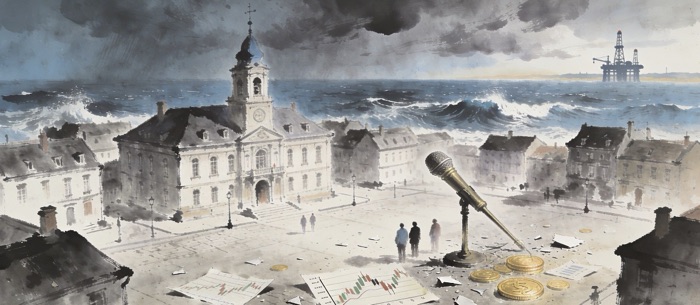
In my view, economics has never been merely about numbers or market fluctuations, it’s a reflection of power. When I see repeated news about US-Iran negotiations, I’m not just focused on the events themselves, but more concerned with why the market reacts so violently. Stock prices swing wildly, oil and gold prices fluctuate sharply, as if the entire world is responding to a few words.
From an economic perspective, this magnifies what we call an “uncertainty premium,” akin to the concept of implied volatility in the Black-Scholes model. Data shows that recent intraday oil price swings reached 15%, far exceeding normal economic cycle fluctuations. This allows leveraged traders to profit handsomely through options arbitrage, while retail investors bear tail-end risks. Iran controls the Strait of Hormuz, which handles about 20% of global oil transport. Any rise in supply disruption expectations pushes up Brent and WTI prices. A $10 increase in oil prices could raise global inflation by 0.6 to 0.7 percentage points, influencing central bank monetary policy expectations and compressing equity valuation multiples. Energy stocks tend to rise amid conflict risk, while tech and consumer stocks suffer under cost-push inflation expectations. The precious metals market reacts more subtly: gold, as a traditional safe haven, often climbs in early conflict stages, but when high oil prices drive inflation and strengthen the dollar, the opportunity cost of holding non-yielding gold increases, potentially causing a pullback.
This is an extension of the economic “principal-agent problem.”

The recent French municipal elections offer a vivid example. In the 2026 elections, first-round abstention rates reached 41.5% to 44%, and second-round turnout was only around 48% to 57.8%, a record low outside pandemic conditions. In cities with tens of thousands of residents, a mayor often needs support from only about 10% of the population (or even less), plus a consolidated core team, to win. A common operational model involves forming a “vote bank” through public sector employees, unions, semi-official organizations, and select developers. When promoting social housing projects, the city government publicly champions equality and diversity, claiming to represent the disadvantaged and uphold political correctness. Privately, however, these policies often benefit specific developers, housing agencies, and even involve local courts, forming a chain of interest transfers. Many immigrants live in these cities but lack voting rights, so the city government only needs to secure support from vested interest groups to maintain power, without truly responding to the broader taxpayer base.
France’s cultural policy suffers from the same structural problem. Much of the country’s social and cultural spending is wrapped in politically correct rhetoric, presenting itself as inclusive, progressive, and morally justified. Yet behind these narratives lies a multilayered system of discourse and power, where resources are funneled toward a small circle of institutions, intermediaries, and beneficiaries. What appears to be public investment in culture often becomes another mechanism through which privileges are preserved and redistributed among a select few.
Behavioral economics fills the blind spots of neoclassical models: people are not fully rational, but anchored by discourse. Trump goes further, leveraging presidential privilege to stage “negotiation shows”; France, by contrast, cloaks elite rule under low-turnout moral packaging. Both share the same essence: how power and privilege manipulate discourse to secure massive benefits for a few, while the majority quietly bear the burden of taxes and inefficiency.

Leave a comment